
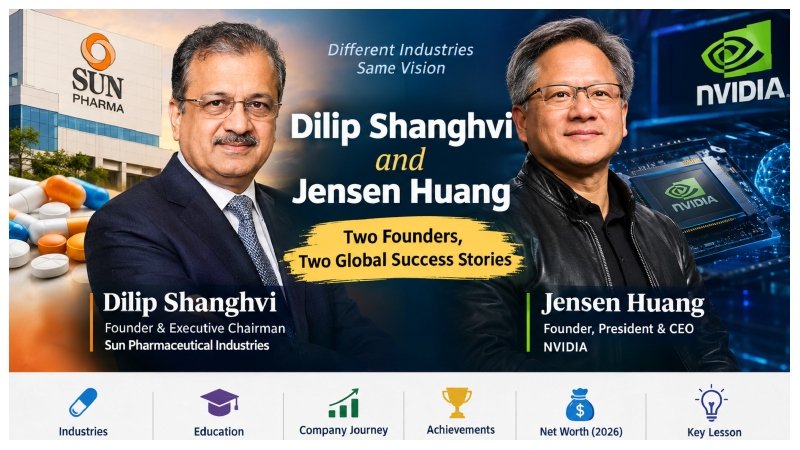
Dilip Shanghvi and Jensen Huang are two globally recognized entrepreneurs who built influential companies in completely different industries. Shanghvi founded Sun Pharmaceutical Industries and helped turn it into a major international healthcare company. Huang co-founded NVIDIA and has led its transformation from a graphics-chip company into a major force in accelerated computing and artificial intelligence.
Their stories are interesting because they did not follow the same business path. Shanghvi built his career around pharmaceuticals, healthcare, manufacturing, acquisitions, and international expansion. Huang built his around semiconductor engineering, graphics processing, software, and computing platforms.
There is no established public evidence that the two entrepreneurs are business partners or relatives. The more useful comparison is therefore about their careers: how they started, how their companies evolved, how they responded to changes in their industries, and why both remain closely associated with the businesses they helped build.
Who Are Dilip Shanghvi and Jensen Huang?
Dilip Shanghvi is the founder and Executive Chairman of Sun Pharmaceutical Industries. Sun Pharma’s official board profile identifies him as the company’s Founder and Executive Chairman and notes that he also chairs Sun Pharma Advanced Research Company. The company began in 1983 and has since developed into a global pharmaceutical business.
Jensen Huang is the founder and CEO of NVIDIA. According to NVIDIA, he founded the company in 1993 and has served as its president and chief executive officer since its inception. Before founding NVIDIA, he worked at LSI Logic and Advanced Micro Devices and earned electrical-engineering degrees from Oregon State University and Stanford University.
The industries may appear unrelated, but both entrepreneurs built companies around long-term technological or market changes. Sun Pharma expanded as healthcare markets became increasingly global, while NVIDIA’s technology evolved from computer graphics into a foundation for accelerated computing and AI.
Dilip Shanghvi’s Early Life and Education
Dilip Shanghvi grew up in a business-oriented family connected to pharmaceutical distribution. Forbes reports that he borrowed $200 from his father to start Sun Pharmaceutical Industries in 1983, initially focusing on psychiatric medicines.
His educational background was in commerce rather than engineering or medicine. Forbes lists his education as a bachelor’s degree from Calcutta University.
That distinction is important when examining his career. Shanghvi was not primarily a scientist who developed a drug himself. His contribution was entrepreneurial: identifying an opportunity, building a focused pharmaceutical business, expanding its operations, and gradually creating a much larger organization.
Sun Pharma’s own history says the company began with just two employees and five psychiatry products. That small beginning became the foundation for a much broader pharmaceutical operation.
How Dilip Shanghvi Built Sun Pharma
Shanghvi’s growth strategy was gradual rather than dependent on one major breakthrough. Sun Pharma expanded its product portfolio, manufacturing capabilities, geographic presence, and business operations over several decades.
Acquisitions became an important part of that expansion. One of the most significant was the acquisition of Ranbaxy Laboratories, which Sun Pharma completed in 2015. The transaction substantially increased the scale and international reach of the combined pharmaceutical business.
Sun Pharma later continued strengthening its specialty portfolio. Forbes notes that the company acquired U.S.-based Checkpoint Therapeutics in May 2025 for $355 million, adding an oncology-focused business to its portfolio.
This history illustrates an important feature of Shanghvi’s approach: Sun Pharma did not remain tied to its original product range. It continued to expand into new therapeutic areas and markets while using acquisitions and internal development to build scale.
Dilip Shanghvi’s Role at Sun Pharma Today
A common source of confusion in older online articles is Shanghvi’s job title.
Sun Pharma’s current board information identifies Dilip Shanghvi as Executive Chairman and Kirti Ganorkar as Managing Director. Shanghvi is therefore still a central figure at Sun Pharma, but he is no longer described by the company as its Managing Director.
His career has also included several public and industry roles. Sun Pharma’s official profile notes that he received the Padma Shri in 2016 for his contribution to Indian trade and industry. It also lists recognitions including the Ernst & Young World Entrepreneur of the Year award and several Indian business leadership honors.
His continued presence at the company gives Sun Pharma a strong founder connection even as professional management responsibilities have evolved.
Jensen Huang’s Early Life and Education
Jensen Huang was born in Taiwan and later moved to the United States. His academic path was strongly connected to engineering and computing.
He earned a bachelor’s degree in electrical engineering from Oregon State University and a master’s degree in electrical engineering from Stanford University. Before establishing NVIDIA, he worked at LSI Logic and Advanced Micro Devices.
This technical background became particularly relevant to NVIDIA’s direction. Huang understood the semiconductor industry from an engineering perspective while also taking on the responsibilities of a founder and business leader.
In 1993, Huang joined Chris Malachowsky and Curtis Priem in founding NVIDIA. More than three decades later, he remains the company’s CEO.
How Jensen Huang Built NVIDIA
NVIDIA’s early business was closely associated with computer graphics. The company developed graphics processors that helped improve the performance and visual capabilities of personal computers and gaming systems.
A major turning point came in 1999, when NVIDIA introduced the GPU. NVIDIA says its invention of the GPU helped redefine computer graphics and eventually contributed to the development of modern AI.
Another critical development was CUDA, NVIDIA’s platform for general-purpose GPU computing. By enabling developers to use GPUs for workloads beyond graphics, NVIDIA created a broader software ecosystem around its hardware.
That decision became increasingly important as machine learning and artificial intelligence developed. GPUs could perform many calculations in parallel, making them highly useful for training and running advanced AI systems.
The result was a transformation in NVIDIA’s business. What began as a graphics-focused semiconductor company became an important provider of computing hardware, networking, and software for AI and data-center workloads.
Why NVIDIA Became So Important to AI
The modern AI boom did not make NVIDIA successful overnight. The company had spent years developing GPU technology and a software ecosystem before generative AI became a mainstream topic.
NVIDIA’s long-term investment in accelerated computing positioned its hardware for machine learning workloads. CUDA also gave developers tools and libraries that made it easier to build applications around NVIDIA GPUs.
NVIDIA now describes itself as a company driving the platform shift toward accelerated computing and generative AI. Its founder remains closely involved in that strategy.
The company’s 2026 annual report also describes AI infrastructure as a major long-term buildout involving computing, networking, energy, software, and advanced manufacturing.
This is one of the biggest differences between Huang’s story and Shanghvi’s. Huang’s company evolved around a technological platform that could support many industries, while Shanghvi’s company developed around healthcare products and pharmaceutical markets.
Dilip Shanghvi and Jensen Huang: Career Comparison
The careers of these founders can be compared through several important dimensions.
Industry
Shanghvi operates in pharmaceuticals and healthcare. His company’s growth depends on drug development, manufacturing, regulatory requirements, intellectual property, distribution, and access to international markets.
Huang operates in semiconductors and computing. NVIDIA’s business depends on chip architecture, software ecosystems, networking, data centers, research, and rapidly changing AI demand.
Educational Background
Shanghvi studied commerce, while Huang studied electrical engineering at both undergraduate and graduate levels.
Their educational paths reflect the different nature of their industries, although neither career can be explained by education alone.
Company Age
Sun Pharma was founded in 1983, while NVIDIA was founded in 1993. Both companies therefore have more than three decades of operating history.
Founder Continuity
Both entrepreneurs remain closely associated with the companies they founded.
Shanghvi is currently Executive Chairman of Sun Pharma. Huang remains NVIDIA’s President and CEO.
Growth Strategy
Shanghvi’s expansion has included international growth, product development, specialty pharmaceuticals, and acquisitions.
Huang’s expansion has involved technological innovation, GPUs, software platforms, accelerated computing, and AI infrastructure.
These differences make their comparison more interesting than a simple billionaire profile.
Sun Pharma and NVIDIA: Two Completely Different Business Models
Sun Pharma and NVIDIA should not be viewed as direct competitors.
Sun Pharma’s core business involves medicines and healthcare products. The company operates across a broad range of therapeutic areas and markets and has built a large international manufacturing and distribution network.
NVIDIA’s business is based on computing technology. Its products and platforms support gaming, professional visualization, scientific computing, data centers, robotics, and artificial intelligence.
The two companies therefore create value in different ways.
A pharmaceutical company must successfully develop, manufacture, obtain approvals for, and distribute medicines. A semiconductor and computing company must continually improve technology, software, performance, and infrastructure.
Their business models are different, but both require substantial long-term investment.
Major Achievements of Dilip Shanghvi
Shanghvi’s defining achievement is the development of Sun Pharma from a small pharmaceutical operation into a major international company.
Sun Pharma says it began with two employees and five psychiatry products. Its later development included expansion into numerous therapeutic categories and markets.
The Ranbaxy acquisition was another defining milestone. It helped significantly increase Sun Pharma’s scale and international presence.
His recognition has also extended beyond Sun Pharma. The company lists his Padma Shri, Ernst & Young World Entrepreneur of the Year award, AIMA Entrepreneur of the Year recognition, and other honors among his career achievements.
Major Achievements of Jensen Huang
Huang’s most significant achievement is the transformation of NVIDIA’s technology and business model.
The company’s invention of the GPU helped reshape computer graphics, while CUDA expanded the usefulness of GPUs for general-purpose computing. Those developments later became important to machine learning and AI.
Huang has also received major industry recognition. NVIDIA lists the IEEE Founder’s Medal, the Robert N. Noyce Award, the Dr. Morris Chang Exemplary Leadership Award, and election to the National Academy of Engineering among his honors.
In 2026, Huang was also appointed to the President’s Council of Advisors on Science and Technology, according to NVIDIA.
His longevity at NVIDIA is another notable part of his record. He has led the company as CEO since its founding in 1993.
Dilip Shanghvi and Jensen Huang Net Worth
Net worth is one of the most searched aspects of any billionaire profile, but it requires careful handling.
A person’s estimated wealth can change significantly because public-company shares fluctuate. Different rankings can also use different dates and methodologies. Therefore, a net-worth figure should always be presented with a date rather than as a permanent fact.
For example, Forbes listed Jensen Huang’s real-time net worth at $187.4 billion on September 16, 2026, while its profile listed him at No. 8 globally at that snapshot. Forbes also says Huang owns approximately 4% of NVIDIA.
For Dilip Shanghvi, Forbes listed a real-time net worth of $26.4 billion as of September 10, 2026. Forbes’ profile attributes his wealth primarily to pharmaceuticals and identifies him as self-made.
These numbers are snapshots, not fixed amounts. A change in Sun Pharma or NVIDIA’s share price can alter the estimated wealth of their founders.
For that reason, readers should always check the date attached to a wealth estimate before comparing the two figures.
Are Dilip Shanghvi and Jensen Huang Related?
There is no reliable public evidence establishing a family relationship between Dilip Shanghvi and Jensen Huang.
Their names are generally discussed together because both are prominent founders of major global companies. Their personal and professional backgrounds are otherwise very different.
Shanghvi is associated with India’s pharmaceutical industry through Sun Pharma. Huang is associated with the semiconductor and AI industry through NVIDIA.
The comparison is therefore entrepreneurial rather than familial.
Are Dilip Shanghvi and Jensen Huang Business Partners?
There is no established public record identifying Shanghvi and Huang as business partners.
Sun Pharma and NVIDIA are separate companies operating in different industries. Their founders did not establish either company together, and publicly available company biographies do not identify a partnership between them.
If their names appear together online, it is generally because writers are comparing two highly successful founders rather than describing a joint business venture.
What Makes Their Stories Similar?
Despite operating in different industries, their careers have several similarities.
First, both founded companies that have survived and evolved for more than 30 years.
Second, both remained involved with their companies for a remarkably long period. Shanghvi currently serves as Executive Chairman of Sun Pharma, while Huang has remained NVIDIA’s CEO since its founding.
Third, neither company remained exactly what it was at the beginning.
Sun Pharma expanded from a small, focused pharmaceutical business into a much broader healthcare company.
NVIDIA expanded from graphics technology into accelerated computing and AI infrastructure.
This ability to evolve is one of the most useful themes connecting their careers.
How Their Business Strategies Differ
The biggest strategic difference is the way each company creates and protects its competitive position.
Sun Pharma operates in an industry where regulatory knowledge, manufacturing capabilities, pharmaceutical portfolios, clinical development, intellectual property, and distribution are critical.
NVIDIA operates in an industry where chip architecture, software, developer adoption, networking, computing performance, and research can determine competitive advantage.
Shanghvi’s strategy has therefore involved building scale in healthcare and expanding into specialty medicines and international markets.
Huang’s strategy has involved building a technology ecosystem around accelerated computing and making NVIDIA hardware useful across increasingly large categories of workloads.
Neither approach is directly transferable to the other industry. Their value as case studies comes from understanding how each founder adapted to the conditions of his own market.
What Can Entrepreneurs Learn From Their Journeys?
One lesson is that a company does not have to remain limited to its original opportunity.
Sun Pharma started with a small group of products and gradually developed a much broader business.
NVIDIA started with graphics technology and eventually became deeply connected with AI computing.
Another lesson is the importance of long-term investment. Neither company became globally significant through a single year of growth. Their development involved decades of product decisions, capital investment, organizational changes, and responses to market shifts.
A third lesson is the importance of understanding the industry deeply. Shanghvi’s career demonstrates the importance of pharmaceutical markets and business execution. Huang’s career demonstrates the value of technical knowledge combined with an understanding of where computing was heading.
Why Are These Two Founders Often Compared?
The comparison is mainly interesting because the two entrepreneurs represent different forms of modern business success.
Shanghvi built influence in healthcare, where the consequences of business decisions ultimately connect with medicines and patients.
Huang built influence in computing, where NVIDIA’s technology has become part of the infrastructure supporting AI and other advanced workloads.
Their companies also illustrate two different types of expansion.
Sun Pharma expanded through products, markets, manufacturing, specialty medicines, and acquisitions.
NVIDIA expanded by turning a core computing technology into a broader hardware-and-software platform.
That contrast makes their stories more informative when examined together.
Frequently Asked Questions
Who is Dilip Shanghvi?
Dilip Shanghvi is the founder and Executive Chairman of Sun Pharmaceutical Industries. He founded Sun Pharma in 1983 and helped develop it into a major international pharmaceutical company.
Who is Jensen Huang?
Jensen Huang is the founder, President, and CEO of NVIDIA. He co-founded the company in 1993 and has led it as CEO since its creation.
What companies did Dilip Shanghvi and Jensen Huang build?
Dilip Shanghvi founded Sun Pharmaceutical Industries, while Jensen Huang co-founded NVIDIA with Chris Malachowsky and Curtis Priem.
Are Dilip Shanghvi and Jensen Huang related?
There is no reliable public evidence showing that the two entrepreneurs are related.
Are they business partners?
No established public business partnership between Dilip Shanghvi and Jensen Huang has been documented. Their companies operate in different industries.
What is Jensen Huang’s net worth?
Forbes listed Jensen Huang’s real-time net worth at $187.4 billion on September 16, 2026. Because much of his wealth is connected to NVIDIA shares, the estimate can change with the market.
What is Dilip Shanghvi’s net worth?
Forbes listed Dilip Shanghvi’s real-time net worth at $26.4 billion as of September 10, 2026. This figure can also change as the value of his investments changes.
When was Sun Pharma founded?
Sun Pharmaceutical Industries was founded in 1983. Sun Pharma says it began with two employees and five psychiatry products.
When was NVIDIA founded?
NVIDIA was founded in 1993 by Jensen Huang, Chris Malachowsky, and Curtis Priem. Huang has served as the company’s President and CEO since its inception.
Final Thoughts
Dilip Shanghvi and Jensen Huang built their careers in two industries that could hardly be more different. Shanghvi developed Sun Pharma through pharmaceuticals, healthcare, international expansion, and strategic acquisitions. Huang developed NVIDIA through semiconductor innovation, GPUs, software, accelerated computing, and artificial intelligence.
Their stories are not connected by a known family relationship or business partnership. What connects them is the scale and longevity of the companies they helped build.
As of 2026, Shanghvi remains Executive Chairman of Sun Pharma, while Huang continues to lead NVIDIA as its President and CEO. Click here for more information.
Looking at their careers side by side shows that there is no single formula for building a global company. One path can emerge from healthcare and pharmaceuticals; another can emerge from computer engineering and semiconductor technology. In both cases, long-term thinking, adaptation, industry knowledge, and the ability to build an organization around changing opportunities played important roles.